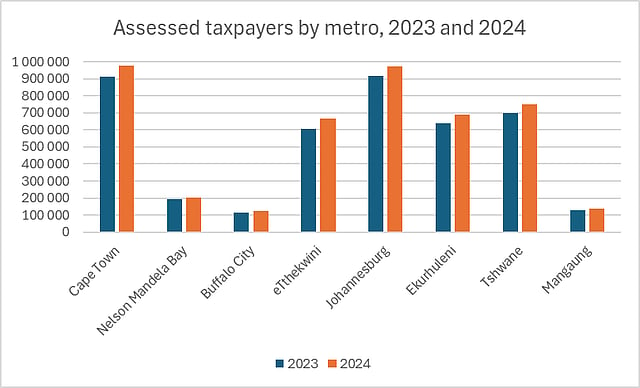
Cape Town has edged ahead of Johannesburg in the number of assessed taxpayers, adding weight to the view that South Africa’s economic centre of gravity is gradually shifting south.
Recent data from the South African Revenue Service, covering assessed taxpayers across the country’s eight metropolitan municipalities, show that Cape Town has now surpassed Johannesburg in absolute terms. In 2023, Cape Town recorded 912,168 assessed taxpayers, slightly behind Johannesburg’s 915,311. By 2024, however, Cape Town had climbed to 975,779, overtaking Johannesburg, which reached 970,892.
The gap is slim — just under 5,000 taxpayers — but the symbolism is significant. For decades, Johannesburg has been widely regarded as the country’s undisputed economic hub. Now, on one of the clearest indicators of formal economic participation, it has been surpassed.
Assessed taxpayer figures offer more than population insights; they reveal where declared income is generated and where formal economic activity is concentrated.
Growth rates further underline the shift. Between 2023 and 2024, Cape Town’s assessed taxpayer base expanded by 7.0%, compared with Johannesburg’s 6.1%. While the difference may appear marginal, in metros with close to a million taxpayers, even a single percentage point represents thousands of individuals — and signals stronger relative momentum.
Several other metros also outpaced Johannesburg. eThekwini (Durban) recorded the strongest growth at 10%, followed by Ekurhuleni (East Rand) at 8.1%. Tshwane (Pretoria) expanded by 7.2%, and Buffalo City (East London) by 7.4%.
Only Nelson Mandela Bay (Gqeberha, formerly Port Elizabeth), at 5.5%, and Mangaung (Bloemfontein), at 6.7%, posted slower growth than Johannesburg.
This does not diminish Johannesburg’s scale or importance. With nearly one million assessed taxpayers, it remains a major economic force. However, its comparatively slower growth points to mounting pressures. Prolonged infrastructure deterioration, electricity instability, governance challenges, and rising municipal costs have eroded business confidence and prompted some residents and firms to relocate — often to the Western Cape. Capital and skilled professionals are increasingly mobile.
Cape Town’s ascent appears deliberate rather than incidental. The city has cultivated a reputation for administrative stability, stronger governance, and a more investor-friendly environment. Visible service delivery improvements seem to be translating into measurable expansion of its tax base.
That said, economic gravity does not shift overnight. Johannesburg retains deep corporate networks, financial services strength, and the advantages of long-standing business clustering. These structural factors still carry weight.
Yet tax data are difficult to ignore. They reflect where income is earned, declared, and spent. For the first time in modern South African history, Johannesburg no longer holds the country’s largest concentration of assessed taxpayers. If current trends continue, the implications — both symbolic and practical — could be far-reaching. The centre of gravity may not have fully relocated, but it is unmistakably tilting south.